My Hamster Python Journey
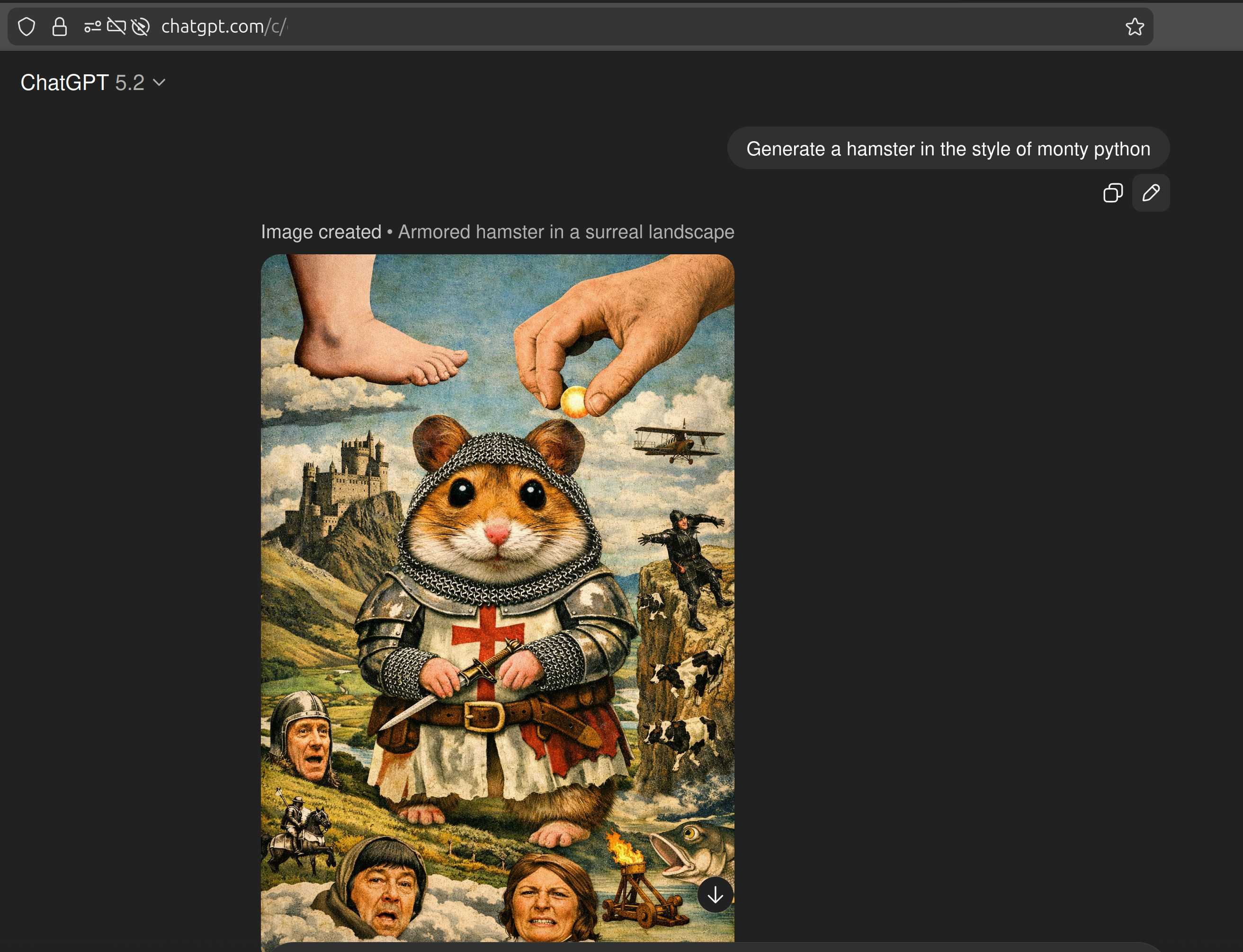
I would like to begin by stating that I am not, strictly speaking, qualified to review human comedy. I am a hamster. My primary academic interests include sunflower seed distribution, wheel-based velocity experiments, and advanced bedding architecture. However, having spent several evenings perched inside a wire enclosure adjacent to a glowing rectangle that projects what I am told is “Monty Python,” I feel compelled to offer my considered opinion.
First, the humans on the screen behave incorrectly.
They move with the jittery unpredictability of a young hamster who has consumed fermented apple. They shout. They dress as women with alarming enthusiasm. They hit one another with fish. As a species that values order—clear tunnels, organized hoards, consistent pellet schedules—I find this chaos both distressing and mesmerizing.
Monty Python, as I understand it, is a collective of long-limbed bipeds who have decided that the proper way to exist is sideways. They enter a room through a wall. They conduct serious debates about completely unserious matters. They begin conversations about philosophy and end them by singing about lumberjacks. It is deeply confusing. And yet, I cannot look away.
From a hamster’s perspective, the most accurate representation of human society is the sketch where authority figures speak with great confidence while knowing absolutely nothing. I recognize this dynamic. I have seen it play out between the Large Food Provider and the Smaller Food Provider. They stand over my enclosure discussing “optimal bedding depth,” neither having once constructed a proper subterranean network themselves. They argue. They cite articles. They ignore the obvious truth: more bedding is always better.
Monty Python understands this absurdity of authority. The knights who say “Ni” demand shrubbery. Bureaucrats debate meaningless forms. Policemen arrest performers for no reason. It mirrors the daily hamster experience: the towering creatures rearrange my habitat in the name of “cleaning,” confiscating perfectly good hidden pellets and replacing my carefully curated tunnels with flat monotony.
If I had the vocal apparatus, I too would demand shrubbery.
What strikes me most is the rhythm. Monty Python sketches operate like a hamster sprinting on a wheel: they accelerate rapidly, reach a feverish peak of nonsense, and then—without warning—stop. Smash cut. Animation of a foot descending from the sky. End of sketch. It is the comedic equivalent of leaping from the water bottle nozzle onto the food dish mid-sip.
The animated segments deserve particular mention. As a rodent, I have great respect for collage. I myself have attempted bedding collages composed of shredded newspaper and strategically placed seed husks. Monty Python’s animations feel like a larger, more aggressive version of this practice. Limbs detach. Heads float. Victorian gentlemen sprout mechanical appendages. It is as though someone took the inside of a hamster’s overactive brain during 2 a.m. wheel time and projected it onto a screen.
There is also the matter of repetition. Humans seem to delight in running jokes—the Spanish Inquisition appearing unexpectedly, the dead parrot that is “pining for the fjords.” I understand this instinct intimately. I too revisit certain behaviors repeatedly: stuffing cheeks beyond structural capacity, testing the structural integrity of cage bars, pretending I do not see the human’s finger until the last possible second.
The “Dead Parrot” sketch resonates deeply. A human insists a clearly lifeless bird is merely resting. As a creature who practices strategic stillness to avoid unwanted handling, I appreciate the power of denial. If I freeze perfectly, I sometimes become invisible. The human questions reality. “Is he asleep?” they whisper. No. I am conducting advanced stillness research. Monty Python captures this peculiar human tendency to refuse obvious evidence when it inconveniences them. The parrot is deceased. The argument continues. It is glorious.
I must also comment on the musical numbers. Sudden bursts of coordinated singing appear with little provocation. Lumberjacks confess. Philosophers chant about their own intellectual mediocrity. There is something profoundly rodent about this. When the house falls silent at night, I too perform spontaneous percussion using the ceramic dish and a strategically launched pellet. It is performance art. The humans call it “please stop.”
Monty Python understands that absurdity thrives in contrast. They juxtapose grandeur with triviality. A knight faces peril but worries about shrubbery. A man debates the airspeed velocity of an unladen swallow with theological seriousness. As a hamster, I find this delightful. I, too, can be seen sprinting heroically across open floor space only to be halted by the existential crisis of encountering a cucumber slice.
The medieval themes are particularly interesting. Castles, knights, quests. Humans in metal clothing clanking about inefficiently. I observe them and think: your cheeks are empty. Your tunnels are nonexistent. Why are you yelling at one another about grails when you could be optimizing storage?
The Holy Grail itself is an object pursued with fervor and little clarity. It reminds me of the mythical “treat jar” on the highest shelf. I know it exists. I have seen it opened. It produces wonders. But I cannot reach it, and so I must rely on the whims of giants. The knights wander landscapes arguing about swallows while their quest remains elusive. This is accurate. Much of existence is wandering, squeaking, and hoping pellets fall from the sky.
The comedy is frequently intellectual, then suddenly profoundly silly. A philosophical debate about the meaning of life will end with a slap or a fish. This oscillation feels authentic. In my enclosure, I will contemplate the geometry of tunnel curvature, then abruptly sprint in circles because a shadow moved. High thought. Immediate panic. Such is consciousness.
Another key feature is the willingness to break structure. Sketches end abruptly. Scenes collapse. Authority figures invade the narrative to shut it down. There is something liberating about this. Hamsters live within strict physical boundaries: bars, walls, lids. Yet within those boundaries, we innovate constantly. A wheel becomes a drum. A cardboard tube becomes a fortress. Monty Python treats the television frame the same way. It is a container to be gnawed through.
Let us address the human habit of men dressing as women with conspicuous lack of disguise. As a hamster, I do not fully grasp human gender constructs. All hamsters look approximately like hamsters, with minor variations in fluff density. The Python approach suggests that identity itself is a costume. It can be exaggerated, mocked, reshaped. From my perspective, this is consistent with the daily human ritual of donning “work clothes” versus “home clothes.” They transform their external fur and alter their personalities accordingly. Monty Python simply amplifies this to comedic extremes.
The pacing is also notable. Long pauses. Awkward silences. Characters staring blankly. I recognize this as a universal language. When I pause mid-wheel and stare into the middle distance, I am contemplating existence. Or perhaps calculating whether the human is about to open the lid. It is ambiguous. Monty Python uses ambiguity as a tool. The joke lingers in the silence.
Violence appears, but it is cartoonish. Limbs detach bloodlessly. People are hit with fish rather than swords. As a prey animal, I appreciate the softness of this absurd aggression. Real danger is sharp and fast. Python danger is floppy and surreal. It is the difference between an actual hawk shadow and a dangling toy shaped vaguely like one.
There is also bureaucracy. Endless forms. Departments for silly walks. Ministries of strange behaviors. Humans seem to enjoy constructing elaborate systems for categorizing their own eccentricities. As a hamster, my bureaucracy consists of three departments: Eat, Hide, Run. Efficient. Monty Python suggests that human systems grow so complex they become self-parody. They regulate nonsense with seriousness. It is a magnificent waste of energy.
I find myself particularly drawn to the physicality. Exaggerated gestures. Elastic faces. The commitment to falling over dramatically. This is advanced slapstick. I, too, have executed controlled tumbles off the upper platform for theatrical effect. The humans gasp. I scamper away. Performance complete.
What is Monty Python, ultimately? It is organized chaos. It is a wheel spinning so fast it becomes a blur, yet somehow remains centered. It is a reminder that structures—social, linguistic, narrative—are fragile. They can be poked. They can squeak.
As a hamster, I live in a world defined by repetition. Morning pellets. Afternoon naps. Nighttime sprinting. Monty Python interrupts repetition. It jolts expectation. When you think the sketch will resolve neatly, it refuses. It collapses. It introduces an animated foot. This unpredictability is invigorating. It is the equivalent of discovering an unexpected seed lodged in bedding previously assumed barren.
There is an undercurrent of rebellion. Authority mocked. Institutions deflated. Grand narratives punctured. Hamsters are small creatures in large systems. We survive by subverting. We chew through the corner of the cardboard house not because we must, but because we can. Monty Python chews through the cardboard of human seriousness.
Even the title sequence—dramatic music swelling only to be interrupted by absurd imagery—reflects this ethos. Grandeur undercut by silliness. I imagine the composers standing solemnly, unaware that an animated appendage will soon descend.
And yet, beneath the absurdity, there is precision. Timing is exact. Wordplay sharp. The nonsense is engineered carefully. This is not random chaos; it is curated chaos. Like a hamster nest that appears disordered but contains hidden compartments of efficiency.
Do I understand every reference? No. My knowledge of British bureaucracy and 1970s politics is limited. However, I recognize tone. I recognize when seriousness is inflated beyond reason. I recognize when a system becomes ridiculous. These are universal.
If Monty Python were translated into hamster terms, it would involve a council of gerbils debating the aerodynamic properties of sunflower seeds while a guinea pig in a false mustache demands a shrub made of alfalfa. A hedgehog would interrupt. A giant paw would descend. The sketch would end.
In conclusion, as a hamster, I find Monty Python to be both perplexing and deeply satisfying. It reflects the absurdity of large creatures constructing elaborate meanings while standing atop fundamentally silly foundations. It celebrates disruption. It honors nonsense. It spins.
When the glowing rectangle goes dark and the room quiets, I return to my wheel. I run. I consider knights and parrots and bureaucrats. I stuff my cheeks. I pause mid-stride and stare dramatically into the void, imagining an animated foot hovering above my enclosure.
And in that moment, I understand: the universe itself may be one enormous Monty Python sketch. We are all characters waiting for a cutaway. We are all one misplaced shrubbery away from transcendence.
Now, if you will excuse me, I must attend to the urgent matter of rearranging bedding in defiance of established authority.